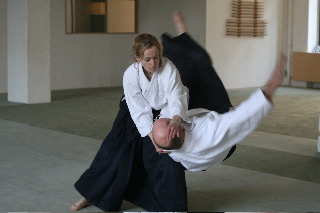
aikido and comedy

I passed a billboard advert for Gatorade – a racing cyclists body with the head and forearms of a scientist looking into a microscope “The science of winning”. There was something about the solemn linearity of this that seemed to me the antithesis of the aiki ethos.

In many ways aiki embraces losing – at least half the time…. I also thought of the hilarity of aikido. I think the aikido situation follows comedic dynamics and the subverted expectation of the joke – looks like one thing is going to happen, it doesn’t, then… ooops! someones fallen over. There is something almost archetypely and inexhaustively funny about people falling over – check “You’ve been framed”.

“Thats the way to do it!”

deep listening into kimusubi

Whilst practicing this evening I realised that the “receptive mode of conscioussness” discussed in my last post really boils down to deep listening – feeling the stick or partner with full attention.

I was delighted to notice how deep listening became energetic bonding (ki-musubi).

The task of motion then simply became moving so that I could “hear” more.

We extended this to partner work with stick. I was surprised and delighted that we were able to freeform out of this work with the stick between us.

deautomatization and the freeforming experience

I would like to pick up on one of the points that Caroline Redl raised in her letter to us “Caroline Redl on Freeform Aikido – a letter”

“I find that your free forms prevents from getting into a routine”.

This is an issue that has been raised by others – “as if something got disorganized inside me” (Else Hartmann-Johnsen)

For me the disruption of habitual ways of being – thinking, feeling, doing is central to freeform practice. To me this relates to what Arthur Deikman refers to as deautomatization.

Deautomitization is an undoing of psychic structure permitting the experience of increased detail and sensation at the price of requiring more attention. With such attention, it is possible that deautomatization may permit the awareness of new dimensions of the total stimulus array—a process of “perceptual expansion.”

… Deautomatization is here conceived as permitting the adult to attain a new, fresh perception of the world by freeing him from a stereotyped organization built up over the years and by allowing adult synthetic functions access to fresh materials.

… The general process of deautomatization would seem of great potential usefulness whenever it is desired to break free from an old pattern in order to achieve a new experience of the same stimulus or to open a perceptual avenue to stimuli never experienced before.

Char Davies has usefully precis of this

This dehabituating of perception tends to occur as a result of certain psychological conditions, such as when the participant’s attention is intensified and is directed toward sensory pathways; when there is an absence of controlled, analytic thought; and when the participant’s attitude is one of receptivity to stimuli rather than defensiveness or suspicion.

Davies goes on to paraphrase Deikman that the undoing of habitual perceptions allows for the experience of alternative sensibilities that includes

  • an intense sense of “realness,” as when inner stimuli become more real than objects
  • transcendence of time and space
  • unusual modes of perception
  • feelings of undifferentiated unity or merging (e.g.; a breakdown of distinctions between things and/or the self and the world)
  • ineffability or verbal indescribability
  • a profound sense of joy or euphoria
  • a paradoxical sense of being in and out of the body
  • Many of these fit with the descriptions of Morihei Ueshibas experiences in Aikido.

    It was the promise of such a breakdown of habitual perceptions and the heightening of these sensibilities that attracted me to aikido. They are now the motivating factor behind the development of freeform aikido practice.

    This deautomatization demands that we shift to what Deikman refers to as the “receptive mode of Consioussness”. This is where our intent changes from one of manipulation of the environment to “taking in” and appreciating.

    The receptive mode presupposes the deautomatization of the intellectual states, which is tantamount to letting things occur rather than make them to occur. This is also called “passive volition”. 1

    This is expressed in our practice by the sense of breathing in our sensation, the inhibition of an emphasis on doing with our hands, by using the whole of our body’s, allowing breath and balance to move us.

    1. Arthur J. Deikman, Bimodal consciousness, in Archives of general psychiatry, 25(1971), December, p. 481-489, and R. Ornstein, The nature of human consciousness. A book of readings, Freeman and Company, San Francisco, 1973

    Caroline Redl on Freeform Aikido – a letter

    Dear Peri, Dear all,

    Even though it is already a few weeks ago, that I visited your dojo, the pleasure of having had the chance to experience your freeform aikido still stays with me.

    Again, thank you all for your very warm welcome!

    And finally, here are some lines from me for your page.

    What was it like for me to experience Freeform Aikido?

    My aikido is based on the forms of Christian Tessier and I’m studying for quite some time with Jan Nevelius and Jorma Lyly from Stockholm, whenever they are in Berlin.

    There are many parallels to the approach, which is also focused very much on the awareness and deep contact with your partner and really accepting and taking on the energy / the attack from your partner.

    So, it was a fascinating experience to practise your Freeform aikido and to find so many links.

    I found that freeform made me very aware and gave me a deep contact with my partner and the group.

    Freeform aikido is like flowing in contact with the partner.

    The timing and speed of our movements came naturally through the contact. Any change of speed was a mutual decision, a result of constant communication.

    Also, I find that your free forms prevents from getting into a routine. As every aikidoka might know, and has experienced throughout countless repetitions of aikido forms, there is a danger of drifting off.

    Freeforming is like acting in the unknown. I have to be in touch with my partner, because I don’t know what is coming next.

    I have to be aware and yet I can give myself fully into the movement the same time. I very much appreciated that.

    I also liked how you included legs, arms and the entire body in the freeforming. That made it a very three-dimensional.

    And getting out of strict rules frees the movement and gets the head out of the way.

    I think Freeform Aikido is a valuable contribution to everybody’s training, regardless what school of aikido I’m coming from.

    I experienced Freeform aikido also as joyous, playful and great fun. It enriches my aikido practice and also my personal development.

    To me it’s a very pure and refreshing free form of the spirit of Aikido.

    Now having written so many words about my experience and my thoughts and knowing that aikido should be practised and not written about, I hope to share more freeforming lessons with you all. And wish you all the best for your dojo, many students, and new discoveries in movement for freeform aikido.

    Thank you!

    Hope to see you all soon!

    from Berlin

    Caroline

    Splicing the felt, and the intended

    Gathering up and connecting the reciprocal yield between stick and player, I felt the integrative relationship between the sticks tip and my feet.

    I wanted to splice this with a more overt outward focus, and linking intention.

    sweet surrender

    As we discussed the evenings practice I said that something had shifted half way through. Carl said that he experienced a sense of surrender, at which point the practice began to flow more.

    I pondered this and pictured both the surrender to the waves and the extension through myself when I have ever body surfed in the sea.

    I remembered John Ferris suggestion of “yield” with its dual sense of non-resistance and giving forth – of profitability!

    dialogue with a stick

    Today we practiced with a stick.

    The play evolves out of a feed back loop between the stick and I.

    The stick, when held freely, responds to my slightest movement.

    I, in turn, attempt to attune to the sticks momentum and align my movement with it. I am again seeking to find and sustain energetic bonding or ki-musubi.

    The stick and I are mutually influencing. The practice dries up, or stutters if I try to master or overtly direct the stick.

    For me, the discipline is to be open to the stick. This again is an example of how freeform practice is emergent from the “between”.

    Here are some comments and observations that Carl Griffiths made on his practice.

    • The “prestige” or trade secret is listening to, and following the stick.
    • To stay in contact with the stick I need to loose my attachments.
    • …this challenges me to steady, continuous listening – and when I do this, I feel liberated from my inhibitions!

    Again, thank you Carl!

    Looking like “beginners”- Naive art and faith

    http://www.find-art.info/littledog

    After practice today we discussed the observation that has been made, that Freeform practitioners look like “beginners”.

    I said I really liked that.

    Carl said that there was something in our practice that was like Naive Art.

    I really liked that.

    I said I like the way our practices seem to come out of nothing.

    Carl said he liked the way he leaves these practices with nothing, except faith.

    I really liked that too.

    Thank You Carl

    Caroline Redl visits Konjiki Dojo

    We were delighted to be joined by the actress Caroline Redl from Berlin as our guest.

    Caroline Redl

    Caroline works with Aiki movement in the training of actors.

    a review of a Freeform Aikido practice!

    We were visited by Mark Walsh, a specialist in Integration Training.

    Mark Walsh photo. Freeform aikido

    He took this photo and wrote this review –

    Last night I had the pleasure of training with these guys.

    They do aikido as a movement art rather than martial art. I really enjoyed it and there was a lot of crossover with Original Play and Paul Linden’s work. The emphasis on expression, intuition, sensitivity and presence was refreshing. Paradoxically, this dancelike way of training is also of great benefit from martial perspective as it teaches aiki in its purest form, and a great workout to boot.

    If you can get yourself to New Cross East London check them out.

    Visit Mark Walsh site

    chaos aikido II

    Again, the comment was raised as to how freeform aikido is emergent from chaos. A quick search of the web bought up the view point that aikido was to wrest “order out of chaos”. This troubled me, as I ask myself “whose order”?

    Maarten Vanden Eynde


    For me, freeform aikido is a way of engaging with chaos, in chaos. I would like to think it can embrace mess, stumbling and confusion.

    For me there is something important in being able to recognize, own and express as best I can, that this chaos is something I am part of, and is me… and you!

    It is out of the mess, the “dancing leaves” * that novelty arises – creation!

    * Robin Williamson The Waltz of the New Moon


    intense bursts

    I have noticed a gradual shift in our “culture” of practice. These days we often group round a practicing pair and enjoy their practice – jumping in and taking over from one of the participants when there seems to be an opening.

    I discussing this shift we were aware that our current practice is highly intense and demanding. Our practice goes through wave motions of intense participation and more relaxed recovery time. This is different to the more steady practice rhythm that we used to enjoy.

    learning from the ground up

    At the end of practice today I noticed that from the waist down I had the feeling of earthiness – like a gro-bag!

    We had spent quite some times working from and on the ground in squats, knee walking and back work.

    I was aware that I had learnt a lot. Yet my learning felt as though it was in my hips down or feet up. This felt different from the learning I experienced as “head-based” which I tend to experience when working more arm-based and standing.

    growing into contact, glowing and marriage!

    Today we looked at “growing into the contact”. I was considering how we can at times contract, shrink or brace ourselves against quick or or threatening impacts. I was interested to see that if we expand into, and with the other, ki-musubi is made and developed without any secondary actions necessary. Nicola Endicott suggested we slow down to experience this. Hiro said he wished to look at simultaneous mutual engagement. We combined these two ideas in our practice. Out of the slow practice I became aware of two things.

    • a “glowing” quality in our approach is needed to bring the contact alive -The Shining!
    • it must be full-bodied not fragmentarily from the limb

    When we engaged with each other in this way I had the image of bride and groom meeting at the alter. Hopefully (for the sake of the ensuing marriage) there is the glowing sense of growing together, a vivid electricity. I was reminded of O’Senseis idea of practice as the “cultivation of attraction”.

    dreamtime

    einscafe.eins.org/einscafeThis morning I woke from a dream. Awake, I shuttled myself from my sense of the dream to more “practical matters”. In doing so I noticed a chage in my “being”. When I stayed with the sense of the dream i was both sensorily aware and immersed in imagination.

    This is the consciousness I have when practicing freeform aikido. It is a curious integration, living vitally in my senses and vividly embodying my imagination.

    For me this resonates with Winnicots ideas about potential and transitional space

    demonstrations of “mastery” or collaborative enquiry?

    I have never enjoyed displays of “virtuosity”, in any field. As a flaunting of the “known” or the well-rehearsed, I find it uninspiring. I am much more excited by the stumbling into the unknown, the unfamiliar, the unpredictable. (Robin Williamson of the Incredible String Band had a nice phrase “inspired amateurishness”.

    I enjoy our current ethos of collaborative enquiry. Freeform Aikido is in a sense “style-less”, by definition, form-less, not defined by the form it may temporarily manifest itself in. For me this contributes enormously to stripping the practice of being a demonstration of “mastery”.

    There is strong egalitarian quality in our coming together to practice. There is no longer a vivid hierarchy organised around the sorting of those who know and can, against those who don’t know and can’t. I think this may reflect our approach to knowledge. Not as a defined commodity that can be handed down In this situation “knowledge is power” and creates a vertically in our relationships. Our current practice has an approach to knowledge as something contextual and evolutionary and played lightly with between us as we go. We are exploring with each other, rather than proving ourselves against each other.

    “lose your mind and come to your senses” – warming up

    I realise that Fritz Perl’s catch phrase “lose your mind and come to your senses” neatly sums up my approach to “warming up”.

    For me to prepare for freeform practice I need to shift mode from “thinking about” and doing, to feeling. That is, grounding my self in my “felt sense” allowing my awareness to play in sensation. In practice I do this by using my inhalation to feel whatever there is to be felt and exhaling into that. Dissolving. Any movements I make are then to heighten sensation in as many areas of me as possible. This of course rapidly bring me to my awareness of my environment, ground and air temperature and others I am working with.

    When facilitating a warm up in a group I am now wary that I will become too much the focus of the groups attention. That they will watch, and do and still leave themselves in the realm of “thinking about and doing”.

    nurturing and protecting

    ” Hold your partner as you would cradle a baby”. Morihei Ueshiba

    Our approach is the antithesis of self-defence in that we seek to protect our partners face, thoat, ribs, breasts and genitals etc (the openings) from weight baring or impact! We also allow are partner joints freedom to move as they require, to avoid twisting or dislocation. We don’t drop our partners but let them down gently. We attune moment to moment to our partners potential and limitations and vulnerability.

    free improvisation – lovely link!

    Here is a link about free improvisation in music which I think almost says it all as far as freeform aikido practice is concerned!

    An approach to free improvisation

    some working principles of freeform aikido

    • create space
    • listen to energy
    • join
    • play
    • express

    beginning with ki-musubi

    Freeform practice begins with ki-musubi. (I don’t like to use jargon, as I think it carries us dangerously away from our actual experience, but, at the moment, I have n’t found a better term to describe the felt sense of shared-energetic-direction). Ki-musubi is in some ways a locking-in with the energetic extension and/or expressed intention of your partner in movement.

    In freeform aikido both parties are active in finding ki-musubi between them. I think it is important to recognise ki-musubi is not the property of anyone, or something I can do, but is something I can be open to as the child of our engagement – born out of our meeting.

    Ki-musubi is the starting point and dive board from which all further action evolves. It is the guide and muse of how the situation elaborates. Ki-musubi is the given creative well-spring of the practice.

    In many ways the challenge of freeform practice is to how flexibly responsive to the ki-musubi we can allow ourselves to be.

    the “between” and presence

    One way i evaluate my practice and can tell whether it is going well, is when i sense the practice evolving out of the “between”. Neither I or my partner are willing a particular outcome. What is between me and my partner, our relating, is the well-spring of what is occuring. The between becomes richer the more prescent, open and available each participant is.

    I have the image of participants “growing” towards the contact with each other – a sense of flowering towards the sunshine of the others presence.

    heres a link to a nice discussion re:grace and the between

    laughing?

    Freeform aikido is a rich source of laughter.

    I am delighted by how much I and others laugh while practicing. In fact, on reflection it could be one of my main reasons for practicing. Laughing in practice has many of the qualities of ki-ai – releasing tension and expressing bound energy. It also has a strong capacity to bond – aiki. I am not surprised that laughing has been ascribed so may health benefits, or that O-sensei exhorted people to practice in a “vibrant and joyful manner”.

    Laughter in practice comes not so much from being a witness to the absurd, but from being a fully immersed part of it!

    do’s and don’ts of freeform aikido (and yes, rules are for fools!)

    do

    • listen, listen, listen
    • breathe – use your inhalation to savour your own and your partners energy, your exhalation to release
    • look for outwardly expressed intention in you partner – even the intention expressed through simply standing is workable
    • convert compression into release-in-connection
    • release internal holding and compression through vocalising
    • have faith in the connection and allow the work to emerge from your connection

    don’t

    • trap, hold or restrict your partners movement (or your own!) This creates antipathy and is a recipe for injury to your partner, particularly their joints. We are looking to expand rather than constrict freedom of movement.
    • feel obliged to make anything happen!
    • cling to your own stability or “form”. Freeform aikido places no value on the conservation of our own balance, or structure – it becomes a pillar of stuckness!
    • try and come up with moves or impose your clever ideas on the process – you will sever the connection

    uniqueness, diversity AND connection?

    Ambient JamFlorence Peake spoke astutely of the possibility of “uniqueness, diversity AND connection”. I immediately realised that is one of the wonders of freeform aikido for me. Within our practice, rather than struggling with the very different energies, postures and attitudes of our practice partners, they are liberated and find space to play in connection – in ki-musubi.

    This feels very different from practices I have experienced in form or kata based practises, where human diversity always seems to be in conflict with the crystaline geometries of a conceptualised technique imposed upon it.

    Freeform aikido practice seems very capable of celebrating the rich and deep diversity of our humanity as it resonates in communion.

    chaos aikido

    An observer (Alison), recently described our free-form practice as “chaos aikido”. I thought this was a fitting and apt title. The obviously unpredictable quality of the practice really typifies “emergent” phenomena – “the arising of novel and coherent structures, patterns and properties during the process of self-organization in complex systems.”( Jeffrey Goldstein).

    One of the delights for me is how the practice is by it nature emergent and self generating. I don’t have to think “what shall I do next?”. The is a constant fountain of new “material” spewing from the “between” of of the practicing participants.

    For me Freeform practice fulfills the promise of O’Senseis Take Musu Aiki – the spontaneous creative experience of Aiki .

    Goldstein, Jeffrey (1999), “Emergence as a Construct: History and Issues”, Emergence: Complexity and Organization 1: 49-72

    skin

    Today we focused on the touch of skin to skin. We played with the surface. We attempted to be with each other sensitive to the fine hairs on our arms and necks and legs. The title of the hymn “abide with me” was floated!

    In this we de-emphasised what is maybe our default orientation the task orientation of joint and skeletal proprioception.

    What emerged was a lighter, fluidity, an ease of opening both in throwing and being thrown, a permission to be borne. The qualities were both diaphonous and snakeish!

    throwing open!

    While practicing yesterday i noticed another point of departure from “traditional aikido”. In traditional aikido work is sometimes directed to suppressing your partners freedom of movement – the lock or pin. These are familiar goals in the practice of “control and restraint” as used in psychiatric hospitals and jails.

    This element is abscent in freeform aikido. In freeform work is directed towards the mutual liberation of movement into new realms, throwing things open.

    The experience is one of expansion in to new possibilities and questions rather than containment, enclosure and control.

    I enjoy this as I have a tendency towards clastrophobia, and a passion for seeing things in fresh ways!

    extension II

    Extension is the fundamental movement of freeform aikido. Its basis really is the co-ordinated spinal extension as expressed through any attempt at vertical posturing both upright and inverted. It becomes expressed as an ambassador of unity though any full bodied gesture or intent for contact.

    Freeform aikido focuses on the co-ordinated spinal extension that informs our verticality, and aims both to unify with this directional impulse, and to lead it beyond support…

    unity and revolution

    freeform aikido is about bringing energy together in order to create revolution – opportunities for change and development or at least a tumble!

    Both as individuals and partners our goal is ki-musubi – aiki “tying together of energy. Out of this unity arises revolution – “turn around” and “a great change in affairs”! (see wikipedia)

    This was highlighted to me after a great practice with Nicola Endicot. She described the core conditions of freeform aikido as “deep listening, sensitivity through touch, a willingness to fully engage and being open to being surprised!”

    being surprised is the delicious chaotic counterpoint to the consummate unity of ki-musubi. the sweet and sour of practice.