unity and revolution

freeform aikido is about bringing energy together in order to create revolution – opportunities for change and development or at least a tumble!

Both as individuals and partners our goal is ki-musubi – aiki “tying together of energy. Out of this unity arises revolution – “turn around” and “a great change in affairs”! (see wikipedia)

This was highlighted to me after a great practice with Nicola Endicot. She described the core conditions of freeform aikido as “deep listening, sensitivity through touch, a willingness to fully engage and being open to being surprised!”

being surprised is the delicious chaotic counterpoint to the consummate unity of ki-musubi. the sweet and sour of practice.

extension

While recently working a lot from the ground I have revisited the aikido notion of “extension”.

Extension for me is the sense of “bringing myself fully to the meeting”. It is both approaching and opening to my partner. It has something of Gestalt Therapy’s coming to the “contact boundary”.

Extension is what procduces the possibility of cohesiveness in the ki-musubi or the blending.

The active and receptive quality of extension transforms the contact from arbitary grabs and pressures into a unified yet morphing stream of evolving contact.

It is this that contributes my experience of the expansion time in practice. Our encounter moves from a sequence of stuttering moments into into one elongated pervasive sweep!

Strangley the sense and necessity of extension becomes for me more acute when contacting my partner from the ground.Working on the ground highlights the necessity for me to bring my whole body torso and head as well as limbs into a vital quality of extension so that that no contact is arbitary or subsiduary.

groundwork

recently we have been lowering our sights.

ground

We have begun where we will eventually end – on the ground.

This has been a liberating experience and an education in itself. The ground can often be a neglected or relegated to a purely supporting role (roll).

We have been exploring involving the ground as a third party in our practice. At times there has been an exquisite parity in the feeling of opening to the ground in the way we endeavour to open to our partners. The ground too becomes suggestive of new possibility.

It has been good to experiment with being sat or lying as our default position rather than standing.

improvisation

It seems to me that the spontaneous creativity of takemusu aiki that O’Sensei spoke of is an improvisation arising out of kimusubi. When I read the work of those who practice improvisation in other arts I am thrilled by how they seem to be speaking of the heart of aiki. Their thoughts are currently a great inspiration to me as we currently practice.

aikido-london-c-and-h-web.jpg

One of the first writers I first came across was Keith Johnstone and his book Improv – improvisation in theatre. His notion of not blocking but in essence saying yes! to what emerges seems fundamental to aiki practice – very much relating to O’Senseis notion of non-resistance.

Stephen Nachmanovitch has written very eloquently. I am glad when he states the first principle of improvisation is to listen, listen, listen. That is the mantra that I feel hold true as the fundamental basis aikido practice.(more to come……)os

Sanford Meisner and freeform aikido?

I am always delighted how other fields can feed into practise. I have been lucky enough to practise with a number of actors who are influenced by the acting approach of Sanford Meisner.

sanford-meisner-freeform-aikido-london.jpg

They have often commented on parallels between his methods and the ones we employ in freeform Aikido. What appeared of primary importance to me was what seems to be Meisner’s focus on the partner in the relationship, and how this frees the actor into spontaneous “trueness”. This is in opposition to an individualistic approach where the actor focuses is on themselves and what they doing to act. From what I have gleaned there appears to be a similar sense that this propels the participants into the moment.

I have only cursorily reviewed Meisner work and would really like to hear from Meisner practitioners who could illumine more of the thinking behind it….

inversion and freeing the undercarriage

dscf2512-web.jpg

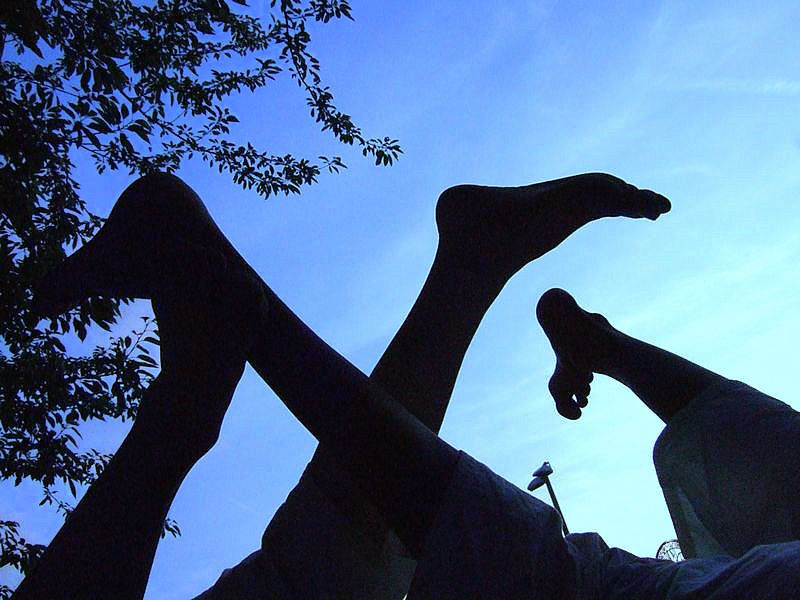
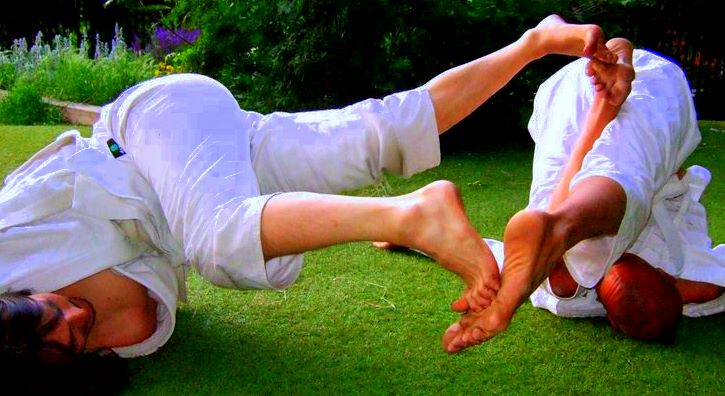
Aikido has always carried a major component of postural inversion – the ukemi roll. This has been a largely under used resource in freeing the use of the legs and lower torso for anything other than the carriage of weight.

Aikido forward roll has the wonderful capacity to allow the weight of the head to balance the weight of the legs. We thus have a ready made way to explore the possibilities of inversion – an area that capoiera has certainly not shied from exploring.

My experience of approaching the use of legs has always felt a bit like exploring the underside of a car – something of forbidding mysteriousness for the novice.

dscf2526-web.jpg

I am delighted now to see ukemi as a royal gate to free up the expressive and connective possibilities of the the legs and feet. The use of the head and chests counterweight possibility also allows the lengthening of the leg in reach rather than the pinching associated with lifting the leg above the hip without counterbalance. This seems to allow an openness and fluidity that is highly applicable within a freeform Aikido practise

where credits due…

I wanted to thank a number of people for the leads they fed me and say something of what I brought out of my encounter with them and then fed into Freeform Aikido.

  • John Ferris – my first aikido teacher. Artistry, humour and his acknowlegment of, and respect to the ineffable. ( And his ability to articulate with sweeping cultural reference.) He highlighted the “implicit” nature of the relationship. I also deeply valued his apparent disinterest in grading.
  • Paul Smith for his lived physicallity and his willingness to go out on a limb. He enlivened me to knees and ankles!
  • Inaba Sensei. From him I took his encouragement to find out what was important to us individually, to experiment and discover for ourselves. I liked his willingness to simplify and his ability to strip away the extraneous.
  • Sasada Sensei. Creativity in experiment and his liberating quietness on what ever we should make of our discoveries. He evoked in me a strong desire to experience the dojo as an artists studio or laboratory.
  • Endo Sensei. His emphasis on relationship. The liberation I felt in hearing him say “my aikido is not a martial art”.
  • Kristin Hestad. For her encouragement to attend to my own experience and her discouragement of my habit to look to historical reference for academic support of my ideas…!
  • Lynne Jacobs.

thanks for everything!

I will continue to add to and embellish this list….

falling. yelling

“You can’t blame gravity for falling in love!” – Albert Einstein

Hiro pointed out to me in todays practice, how i tend to “vocalise”, sing,
yell, “kiai” when falling out of balance. I was intrigued by this
observation.

I reflected that I experience relief / joy in those moments.
Micheal raised the parallel of “petit mort” the little death.

I remembered that much of my early attraction to aikido was falling. Much of
my dissapointment in judo was the tendency to resist falling. As a child i was extremely interested in the stuntmen and women who fall for a living.

freefall

In the zen training I did, there seemed to be a strong theme of falling. I
remember a story told by my teacher Myokioni (who died recently). She told
of the person hanging on a cliff-face holding onto a root. Above, hungry
tigers prowl – below, an abyss. The person sees a wild strawberry growing out of the rock face
and , reaching out to taste, lets go of the root…

How sweet!

Click here for further falling fun!

Peri

Square and control?

The idea of aikido have sometimes been illustrated with the use of the
shapes triangle, circle and square. My son Kit was talking to me about
these.
I then thought of how I had heard the square described as representing
control. I realised that for me now, control has very little place in how I
understand aikido.

For me control implies one will imposed upon another. For
me what is interesting and excites me is the unpredictable creation that
emerges from between the practioners in their meeting. For me this is the
antithesis of control.

Aiki promises me an alternative to the stern
predictability implied by the notion of control.

Peri

balance as finite or infinite resource

On reflection on Paul Goodman’s quote I became aware of various attitudes to
balance that we embody in our practice.
I thought that we can practice as though having our balance is a limited and
scarce resource we might fear loosing and thus cling rigidly too.
I thought that we can also practice as though balance is an infinite
resource.

This then encourages me not to cling to my states of balance. I am
then able to more freely identify with what I become ( as Goodman says) and
flow, fall and feel free with my partner. I am less defensive of my
balance with a fear of loosing it.

As one my partners commented, when I
practice with that attitude she noticed a sense of lightness in our
practice.

Peri

victory, loss and creative disinterest a quote from paul goodman

“The opposite of the need for victory is ‘creative disinterest.’… [a] peculiar attitude of the spontaneous self. the creatively impartial woman win or lose; she is not attached to what might be lost, for she knows
she is changing and already identifies with what she will become. With this
attitude goes an emotion that is the opposite of the sense of security,
namely faith: absorbed in the actual activity she does not protect the
background but draws energy from it, she has faith that she will prove
adequate.” -Perls, Hefferline and Goodman (1951/94, p.132).

or_ukemi1.gif

discovery through experiment

Freeform aikido is a continual and intense learning process of discovery through experiment. Practitioners are encouraged to base their learning and practice on their actual experience through experiment rather than through the introjection of their teachers view points or philosophy